

Case study
Langhua Diary
A WeChat mini-app that cares about your mood.
role
Only designer
Platform
WeChat mini-app
My Contribution
UI / UX Design
Product Management
Branding
Introduction
Langhua Diary is a diary app that tries to make writing diary simpler. Unlike other diary products, Langhua Diary integrates with WeChat official accounts , and any time you send text, pictures, location and other information to the official accounts, it becomes the diary of the day, as simple as chatting.
In terms of diary functions, Langhua Diary has also made a lot of interesting attempts, such as mood calendar and time machine: the "mood of the day" design has been added to the product, which allows you to choose the most compatible emoji as the mood of the day and summarize it into mood trends, which can be viewed by week, month and all, so you can see your recent mood fluctuations directly; the time machine function will remind you of what you wrote a month ago or a year ago.
Welcome to search "浪花日记" on WeChat to experience it.
*"Langhua" means sea spray in english.

The inspiration
About ten years ago, I was a user of a journal product named “Ohlife”. Like all great ideas, OhLife works quite simple: Every day, OhLife will send you an email that asks: How did your day go? All you have to do is reply to the email; then the content will be recorded as your journal of the day.
What makes Ohlife a great product?
Despite its elegant website design, Ohlife creates a brand new way to write journals. To those people who don't keep a digital journal, writing journals could be a burden. Writing journals mean these procedures: sign in the website, write down your feeling, upload a photo. Then repeat it the following days. That's why it's hard to build a habit of journaling, although there are many journal tools on the market.
Email is different, and people use it almost every day. Journaling and email seem like different kinds of product and not relevant at all. But when Ohlife put them together into one product, something interesting happened: it makes writing journals much easier and less stressful.
- First, you don't need to remind yourself to write journals anymore, it's a great relief. Whenever you open your email, it's there, just reply.
- Second, it makes the writing experience personal. You can decide when to reply and what to write. And the content is entirely based on your mood, if you have a meaningful day, you can write down the whole story; if you feel tired and don't want to talk, just ignore the email, it's fine. It's incredibly flexible.
Overall, Ohlife is a simple and neat tool without any clutter. I kept writing about 1000 journals until it had shut down in 2014. After Ohlife closed, I tried some journaling products with similar features, but almost all of them were far from Ohlife in terms of design and experience. So I went back to the physical handbook.
In the next few years, instant messaging tools at home and abroad developed rapidly and gradually occupied more and more usage scenarios, especially after WeChat released its mini-programs, we started to think of tools that combined diary and IM.
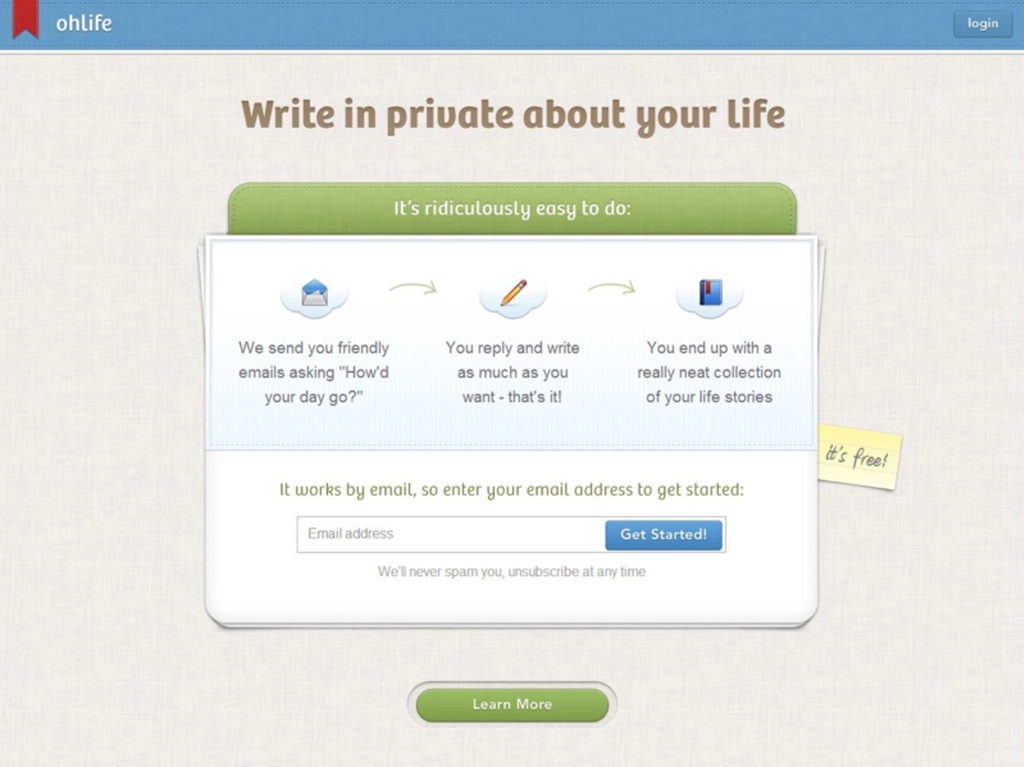
Ohlife website screenshot
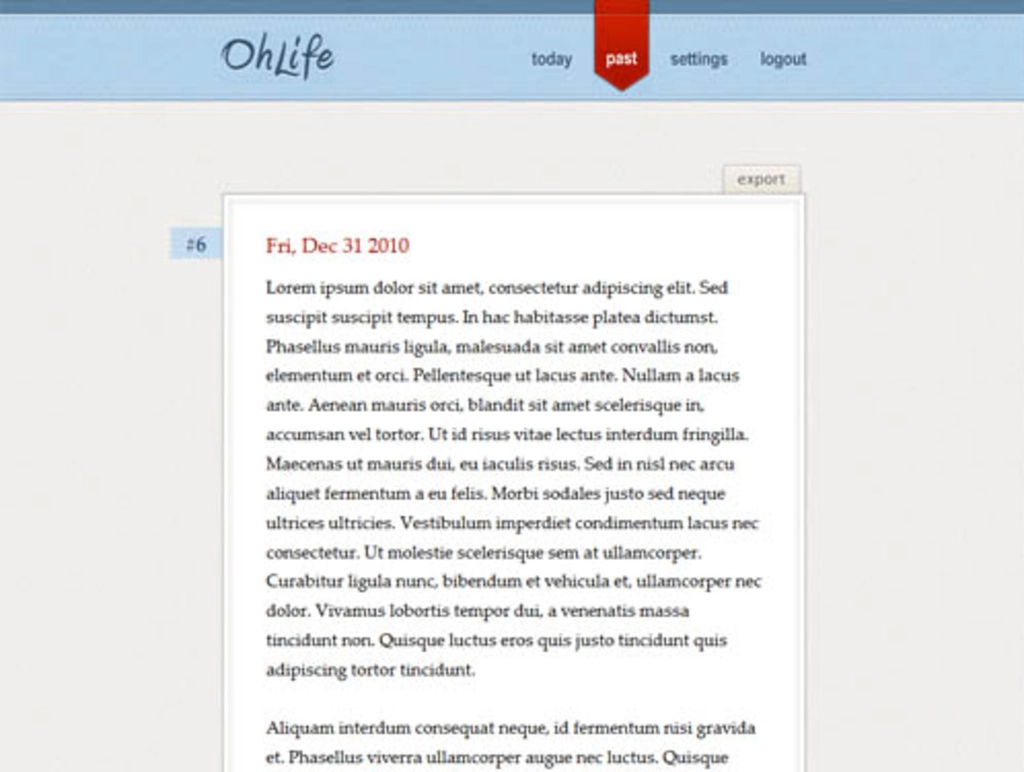
Ohlife website screenshot: Journal page
Where to start?
WeChat occupies a large amount of users' screen time and gradually expands the scenario from chatting to shopping, finance, travel and many other fields. It is one of the absolute "high-frequency" products among all products, and users have formed the habit of opening it every day to check it, so there is no need for additional memory burden. To create a new product, we need to establish a mapping relationship between "scene" and "product" in users' minds, and only when the mapping relationship is strengthened to a certain extent will users remember to open this product when they encounter similar scenes. Following Ohlife's idea, we added "diary writing" to users' daily use paths, without the need to establish the mapping between "scenes" and "products", and let users do the diary writing naturally. The most common operation of users in WeChat is chatting with their friends, so if we can finish the diary writing process through chatting, it will not need to change users' usage habits at all, and it will be a natural process for them.
Goal
Langhua Diary aims to make "keeping a diary" as simple as chatting.
Product Exploration
How to write a diary?
To achieve a "natural" diary-writing process, we thought of using a public account. Besides publishing content, a public account can also receive messages from users. By integrating the mini-program with the WeChat public account, we can enable users to send text, images, location information, and more to the public account at any time, which then becomes that day's diary entry. The process feels like confiding in a close friend. Additionally, considering users' familiarity with mini-program products, the mini-program also needs to have comprehensive diary functionalities: writing, viewing, editing diaries, and checking personal information. Thus, we began conceptualizing the design of the mini-app.

We decided to use WeChat public account and mini-app to build this product.
What is the core of a diary?
Before we started planning the features of the diary app, we were thinking: What is the core of a diary?
The answer we found was that diaries are about moods. Everyone's mood inevitably goes through ups and downs, happy, sad, frustrated, uncertain ...... these particularly private emotions are usually not easy to express, and there is usually no product to record these moments, and the positioning of the diary is a private space, so "record user mood" also became our goal.
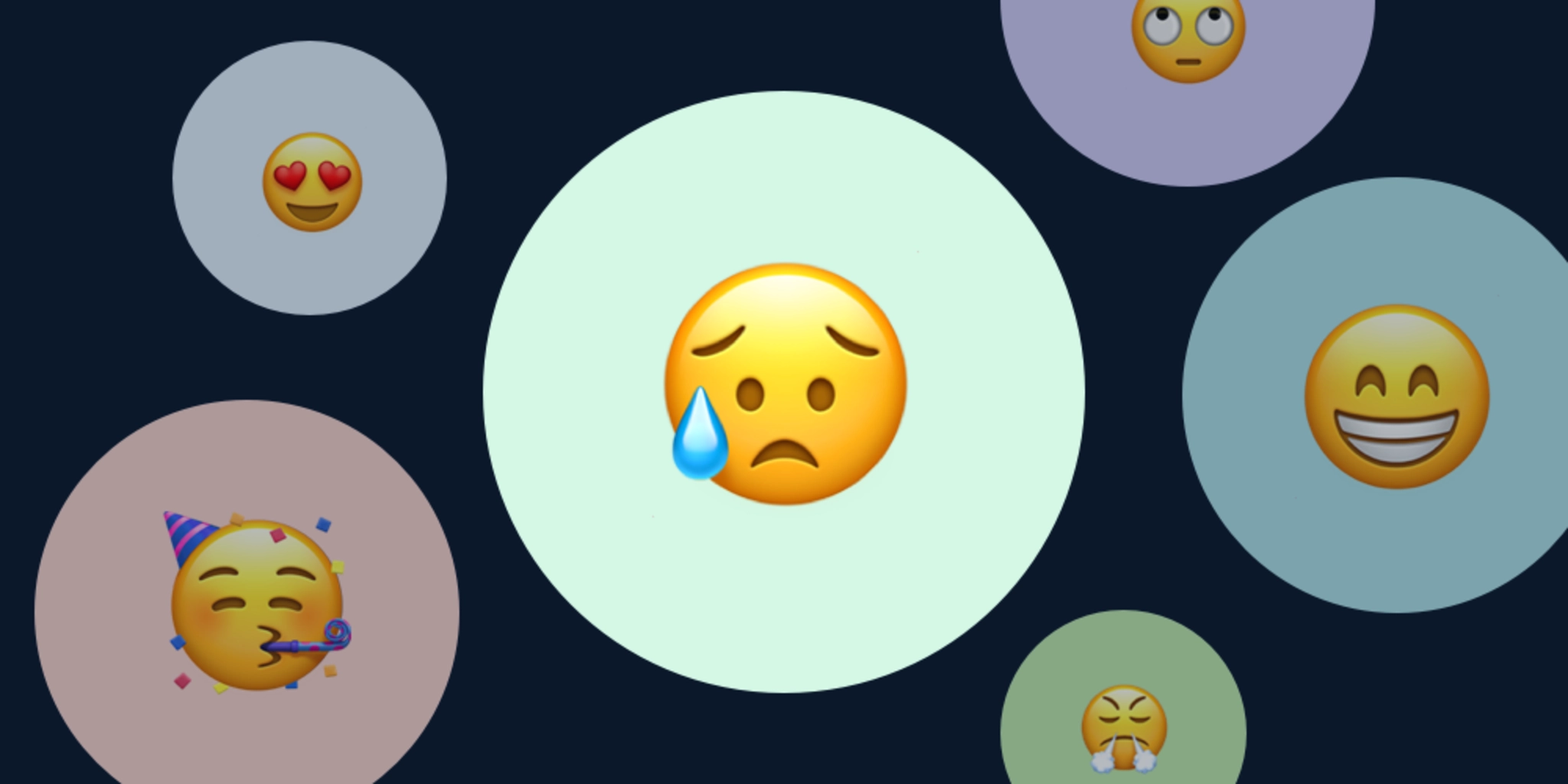
Mood
Mood
The development of instant messaging tools and social networks has brought about a variety of personalized ways of expression. Text alone can no longer meet users' expressive needs, and more and more users prefer to use emojis or GIFs to convey emotions. Emoji has even become a standard feature across all social platforms and communication tools.
The reason lies in the simplicity, intuitiveness, and universality of emojis, which can convey complex emotions with almost no learning required. Therefore, we designed the "Mood" feature. Users can set their mood for each day's diary, and they can also set multiple moods throughout the day. If users send an emoji to the mini-program via the WeChat official account, we will also recognize it as the mood for that day.
When writing diaries as children, we would often note the weather of the day. This scenario reminded us that, in addition to genuinely recording "moods," the concept of mood also has strong versatility—it can be used to note the weather, exercise, work, and even food. To this end, we referred to the annual Emoji rankings released by Emojipedia, as well as the classification of emojis by platforms such as iOS, Android, and WeChat, and re-categorized them based on the context of diary writing.
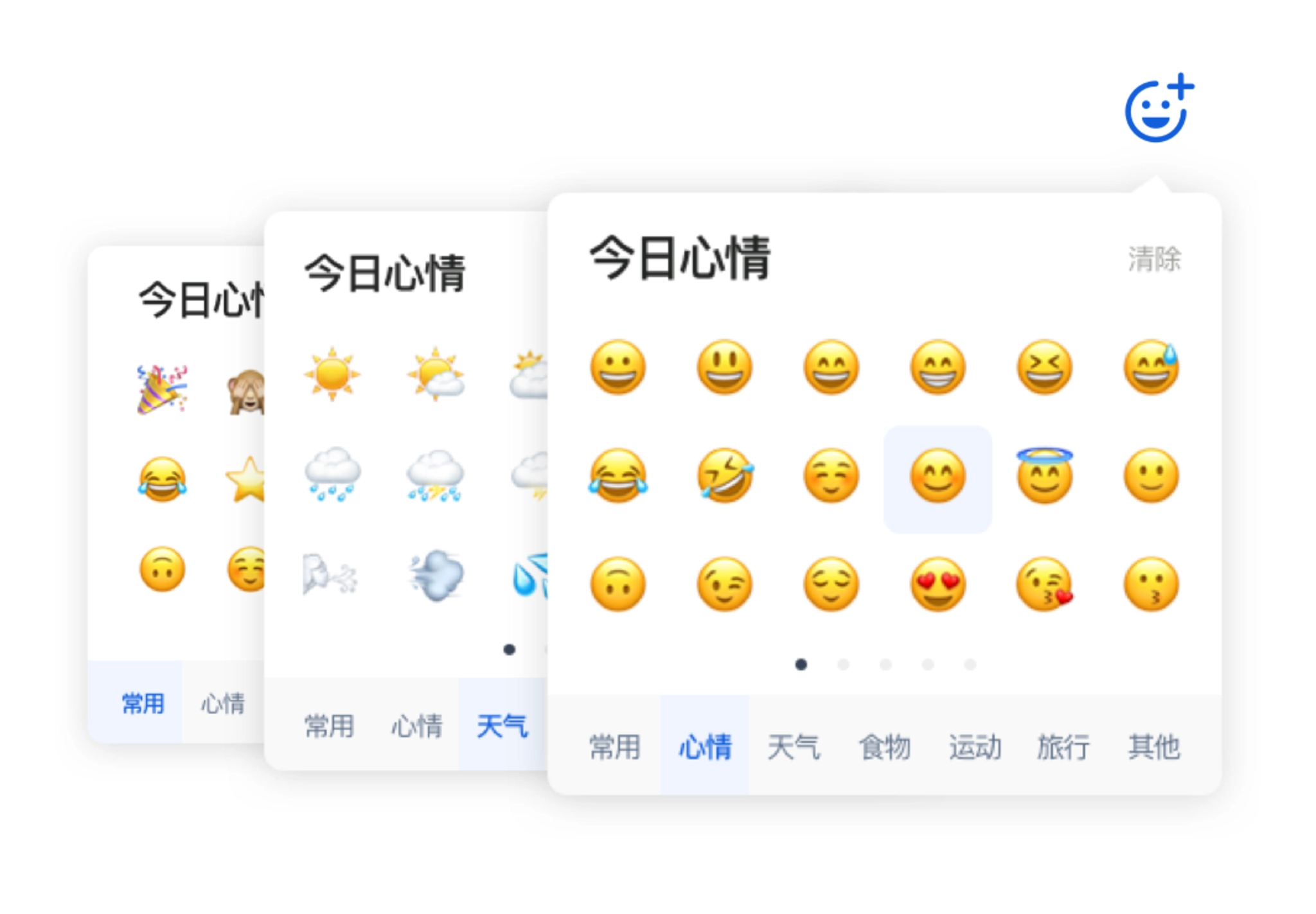
Add mood for the day.
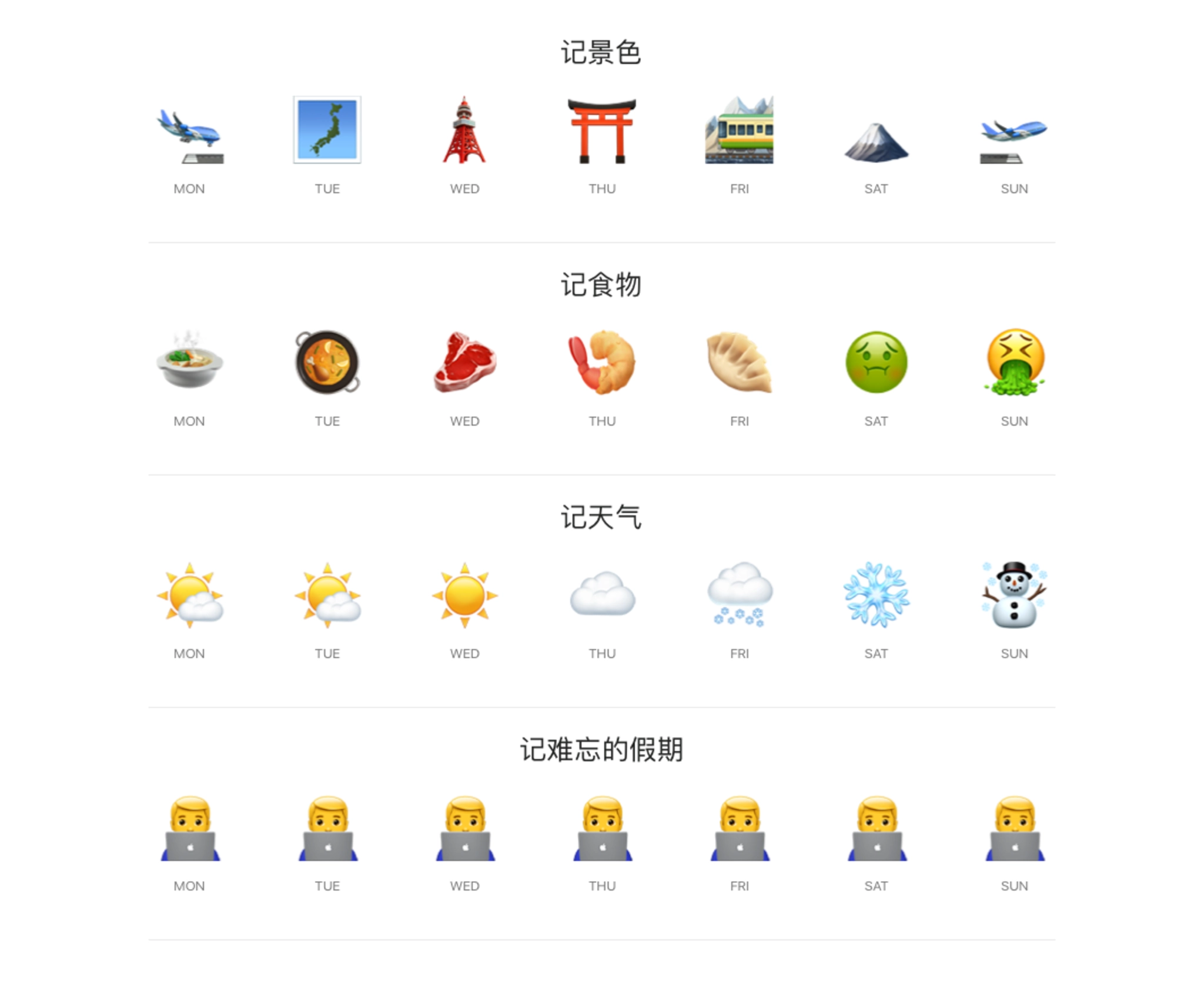
The concept of mood also has strong versatility—it can be used to note the weather, exercise, work, and even food.
Mood Calendar
Mood is not a fragment, but a continuous experience, so more than the daily mood, we are concerned about long-term mood changes, through a longer cycle of mood records, in order to reflect the recent in experiencing lows or highs, has been the need to make adjustments.
That's why we provide the function to view the mood trend visually on the product: mood calendar. The mood calendar aggregates the moods set by the user every day by month and displays them in the calendar so that users can quickly review the mood trends for the month and see the ups and downs of their mood.
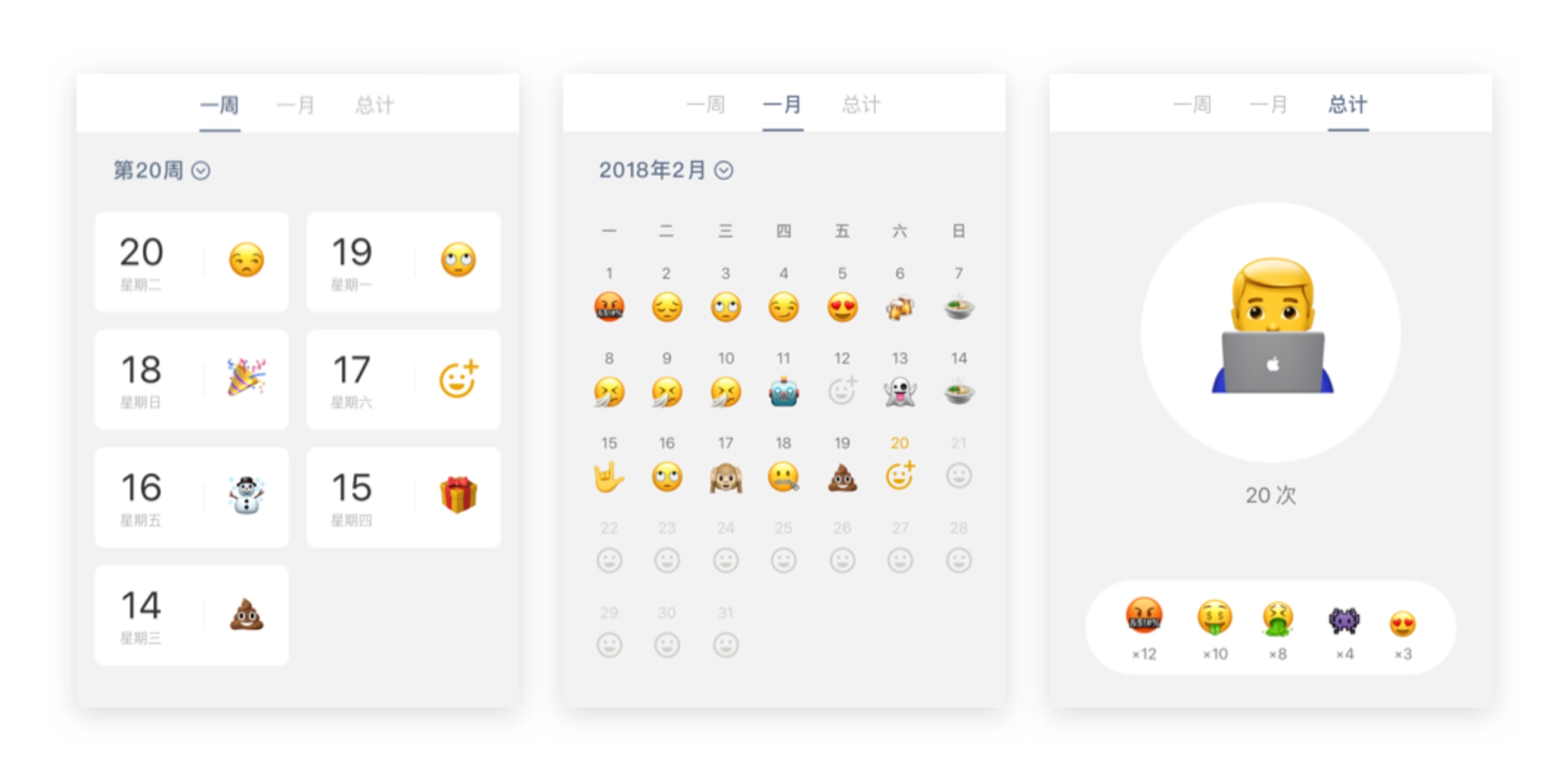
Mood calendar
Content format
Digital products have a natural advantage in the richness of recorded content, such as posting sentiments, sending pictures, and sending locations have become daily operations for users. We also took advantage of this advantage to add support for multimedia formats such as pictures and locations to the diary product, and to achieve the function of recording the pictures and locations sent by users directly through the public into the diary of the day.
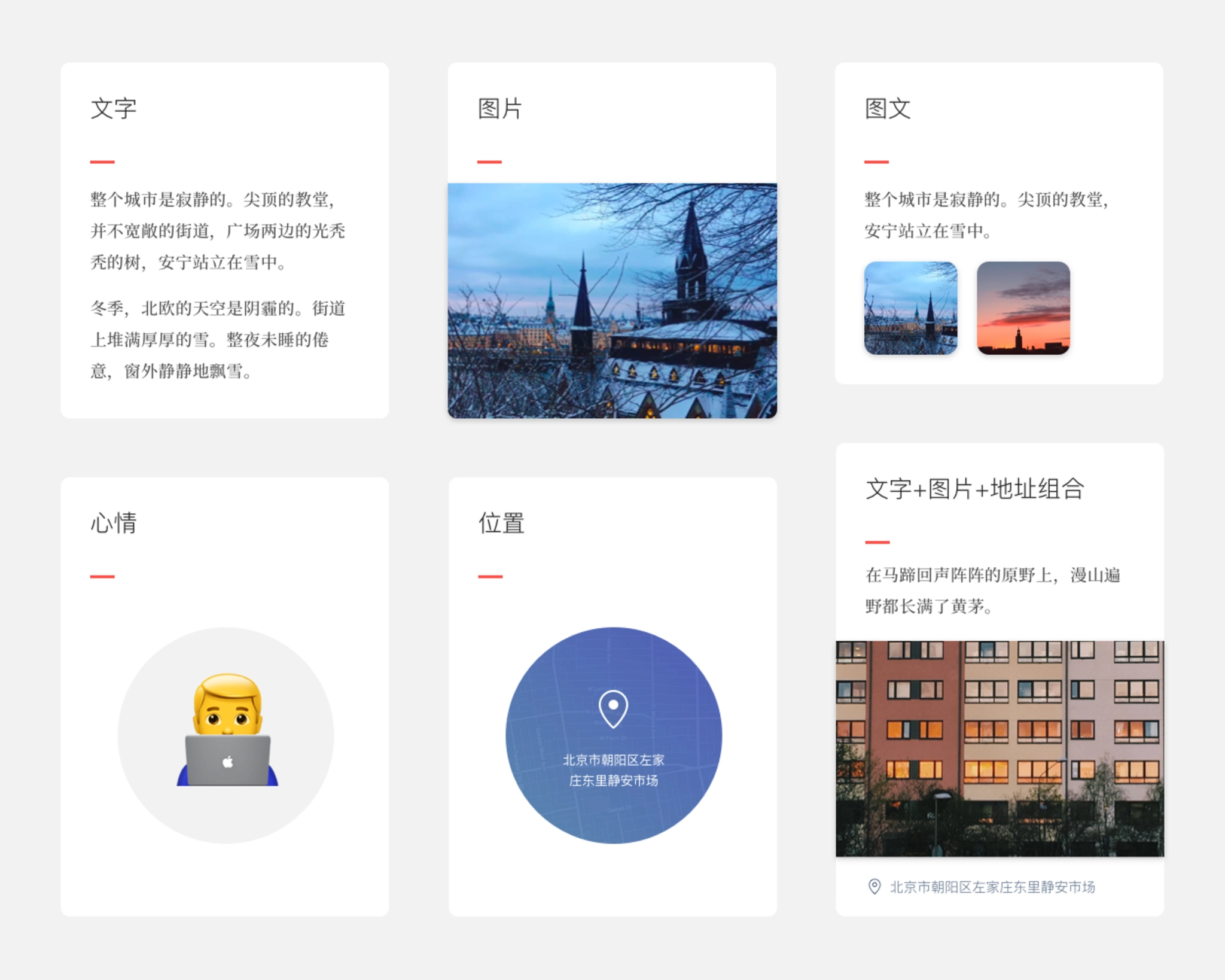
Texts, images, mood, locations were supported in diary.
Let every moment of different moods have a way to be recorded
In Langhua Diary, you can record text, emojis, images, and locations. By combining these formats, you can create a diary experience that meets the needs of different types of users.
For example, if you have an active mind and constant inspiration, you can use the diary as an idea collection box, jotting down thoughts as they come to you through the public account.
For example, when you're in a bad mood and don't feel like talking, you can send an emoji to represent your feelings; when you do feel like talking, you can also write lengthy text.
For example, if you enjoy photography, you can post the photos you take each day to the public account, turning your diary into your photo album.
For example, when going out for fun, you can add a location and pictures taken at each new attraction in your diary, making it your travelogue.……
No matter what mood or situation you're in, Langhua Diary can flexibly help you record your day.
Time Machine
Diaries are not only about the present moment but also about memories. It's an interesting experience to look back at previous entries after some time. In the product, we've added the Time Machine feature, which allows you to review diaries written some time ago.
Visual Design
Writing and Reading Experience
Visually, the most important aspects of a diary are the writing and reading experience. Although digital products offer far more features, the tactile experience of writing with pen and paper is unparalleled. Additionally, we appreciate the reading experience provided by a well-designed magazine.
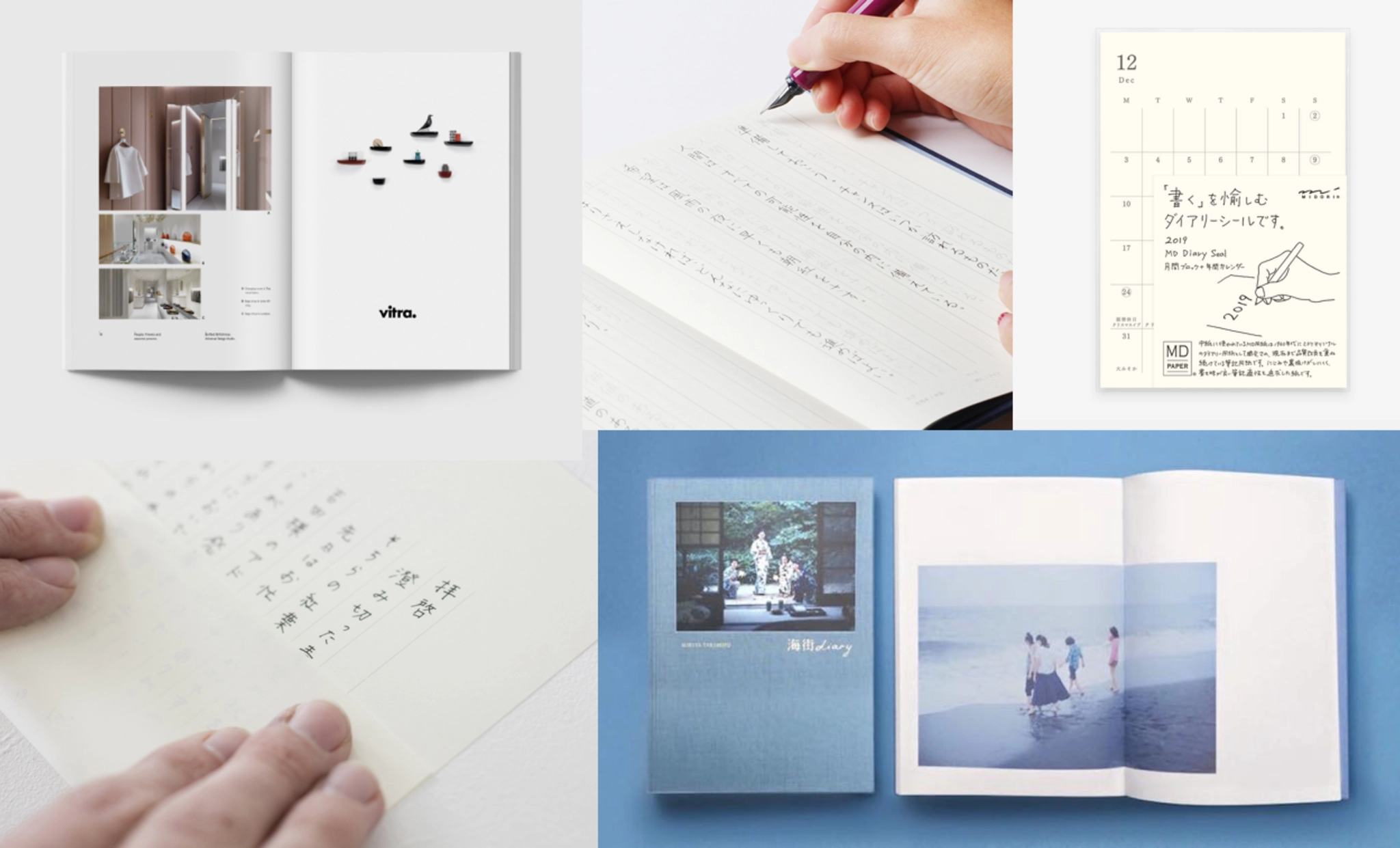
The diary product aims to convey a gentle and elegant reading and writing experience, just like a well-designed magazine.
Layout
Although we cannot directly replicate this writing and reading experience, we can simulate this sense of familiarity through visual elements and typography, so the initial exploration primarily focuses on these two directions.
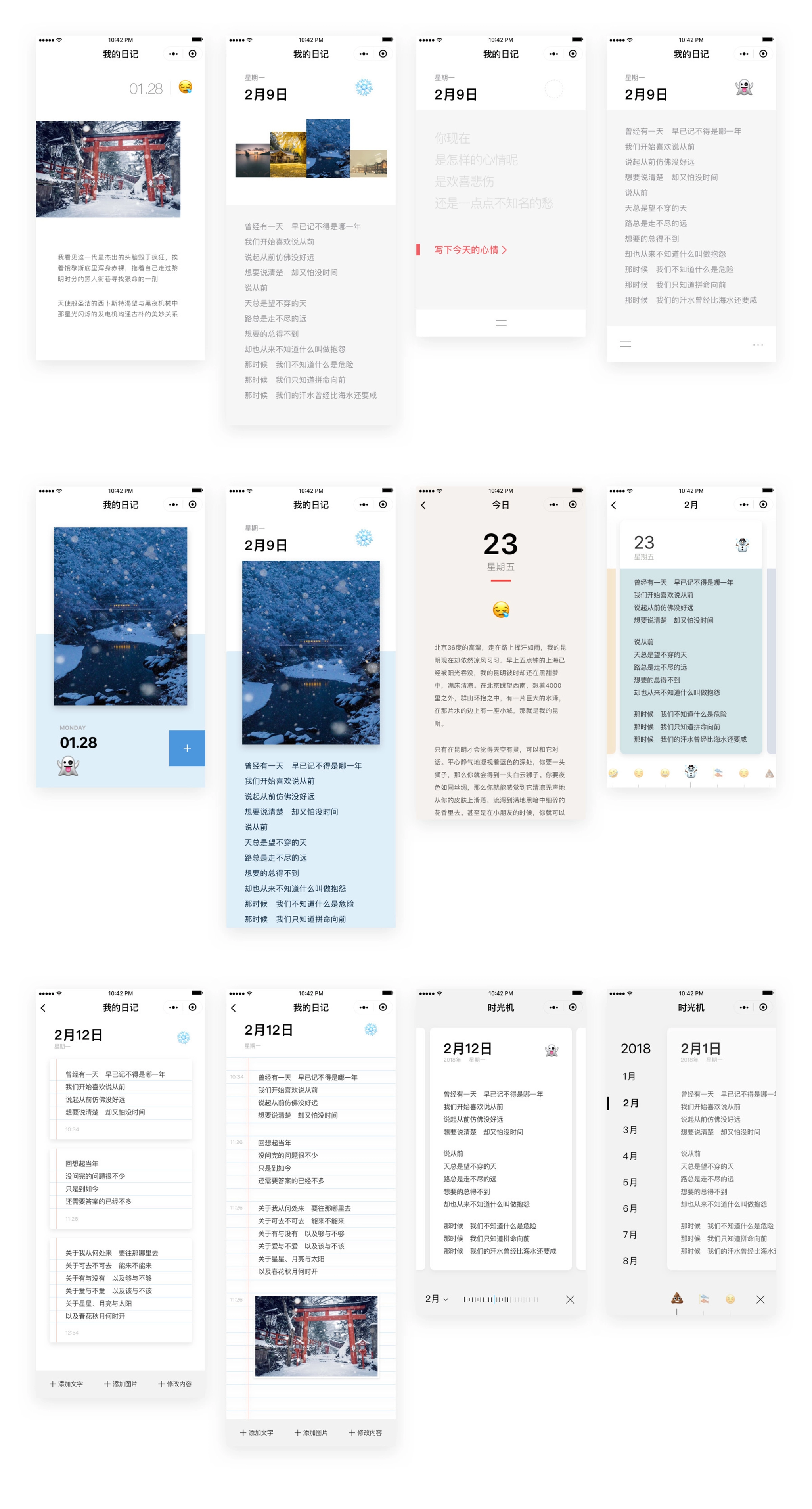
Design exploration of the diary page.
Color
We hope that users can express themselves freely and relaxedly while writing their diaries. To visually minimize the pressure of usage, we have pursued simplicity in both color and style, making extensive use of white and light gray. For the highlight color, we chose a deep blue that conveys the feeling of "ocean waves" and resembles the color of the sea.
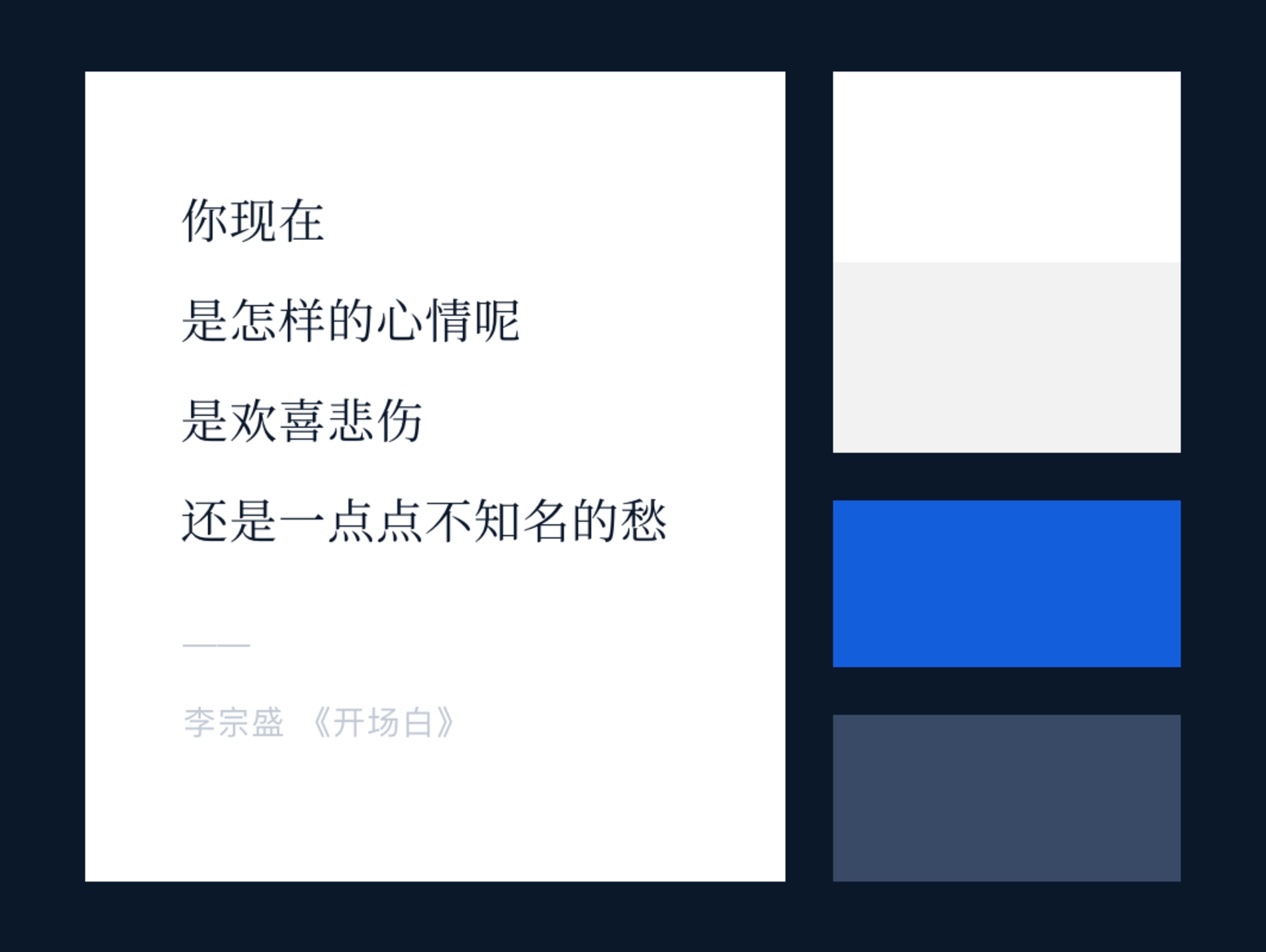
Color palette
Icon
We hope the product can create an approachable, friendly, and relaxed environment, so we adopted soft, simple wireframe icons in the design.
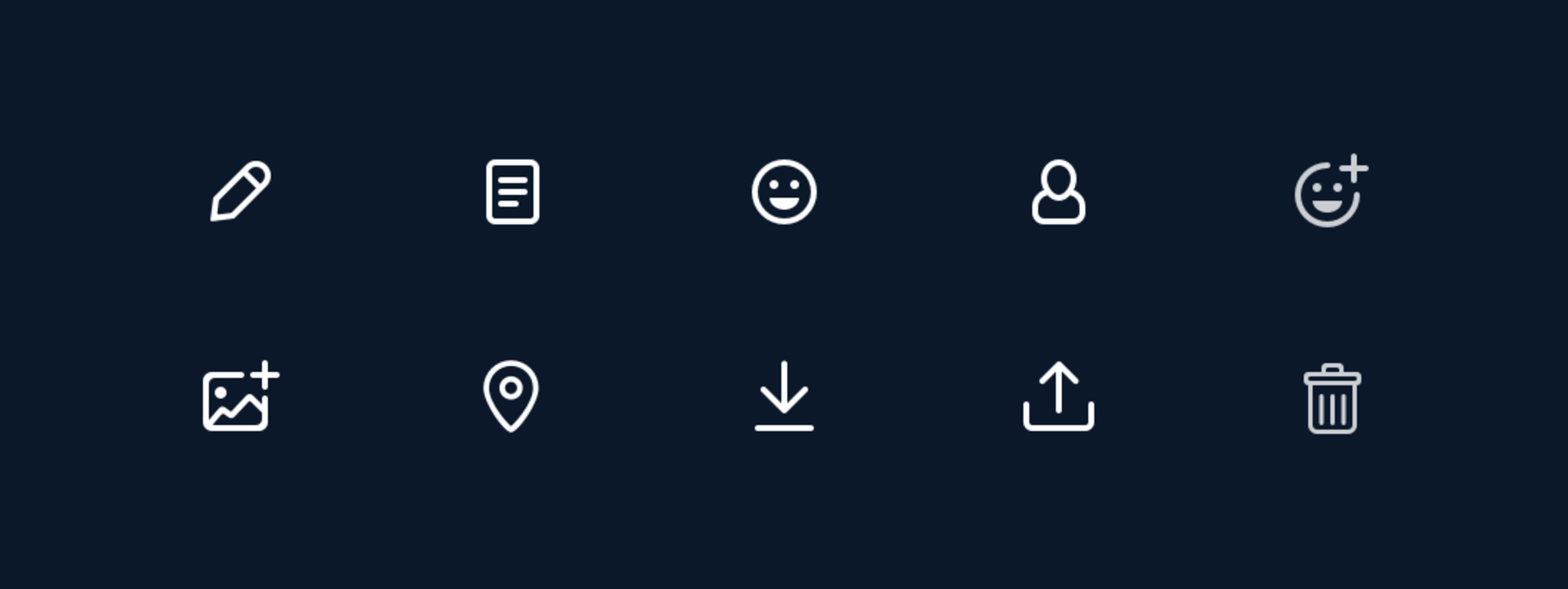
Color palette
Logo
The diary product is called "Langhua Diary"("Langhua" means spray in english). How should the visual image of "Langhua" be conveyed? And how can it communicate that it is a product related to diaries? Or should a simpler and more understandable icon of a pen or notebook be designed?
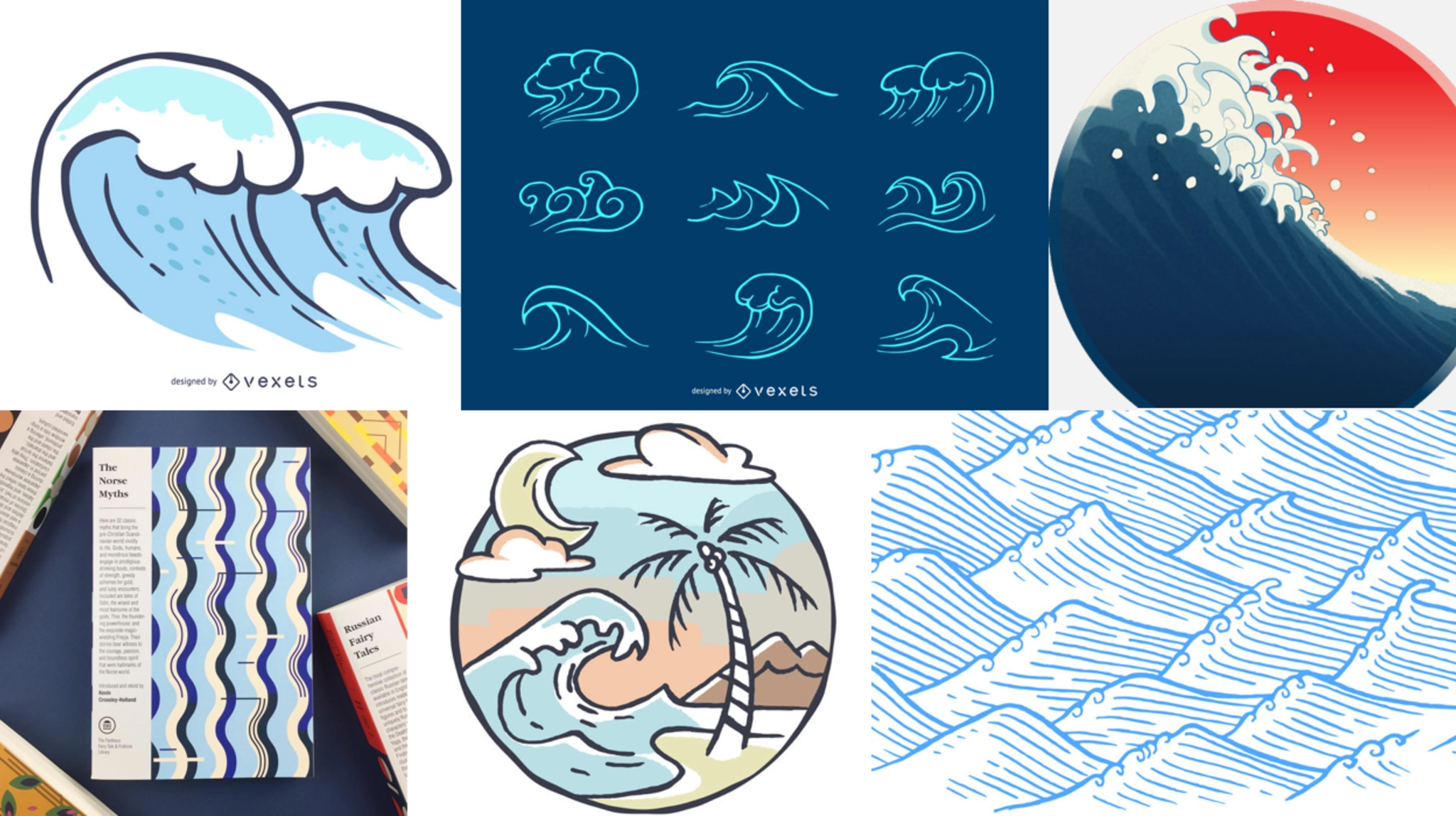
Design inspiration
After many attempts with "Langhua," I suddenly realized that the abstract shape of ocean waves closely resembles the strokes left by a fountain pen on paper, which inspired the design of the product logo.
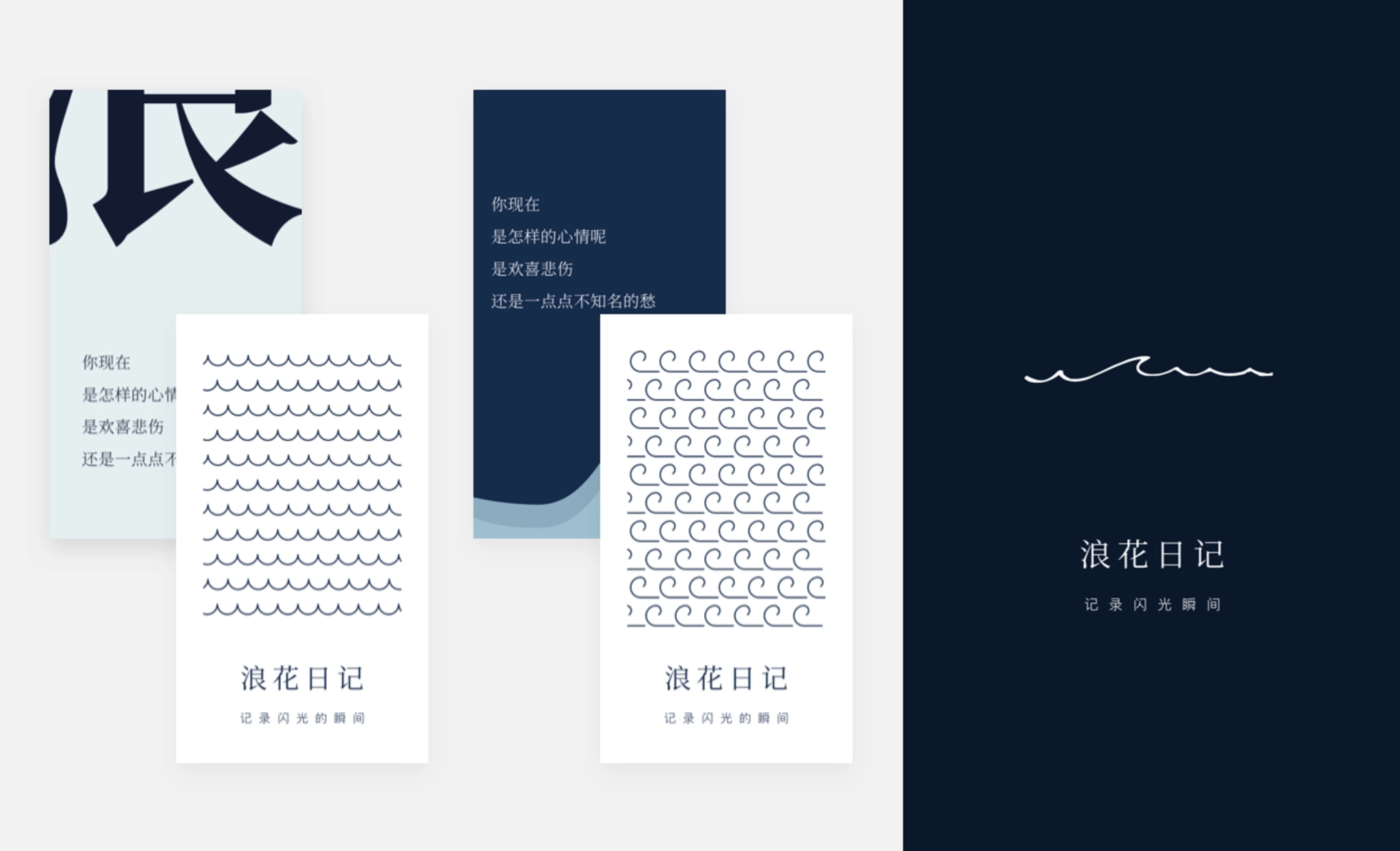
Logo design exploration
Information architecture
The design exploration process favored individual pages that lacked a unified structure, so it was necessary to stop and consider the product's information architecture.
Today
The main scenario we envision is using the WeChat public account to keep a diary, with the mini-program serving as an auxiliary tool. Apart from newly registered users, most of the traffic for the mini-program comes from the viewing links returned by the public account after a diary entry is successfully recorded. Therefore, the most important functions in the diary mini-program revolve around today's diary, including viewing and writing diary entries.
Past Days
At the same time, to make it easier for users to view past diaries, we have also placed "Past Days" in the navigation, organized by month.
Moods
"Moods" is one of the more interesting features of the product, simple and versatile enough to motivate users to try our product. We wanted to promote this feature to users and make "Moods" a separate navigation feature.
Personal
Additionally, user data, settings, and other functions have been integrated into the "Personal" page.
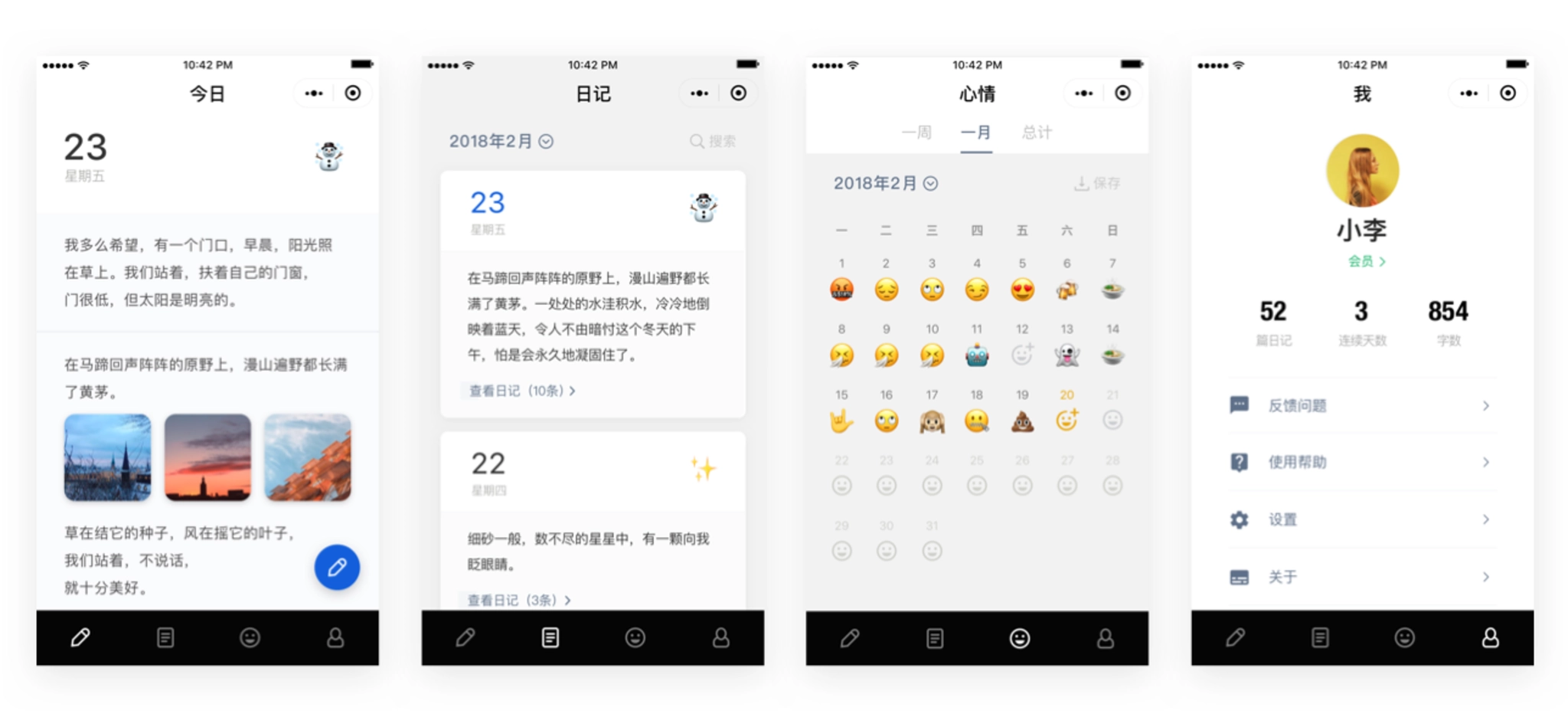
Main pages of Landhua diary.
Final Design
Welcome to search "浪花日记" on WeChat to experience it.
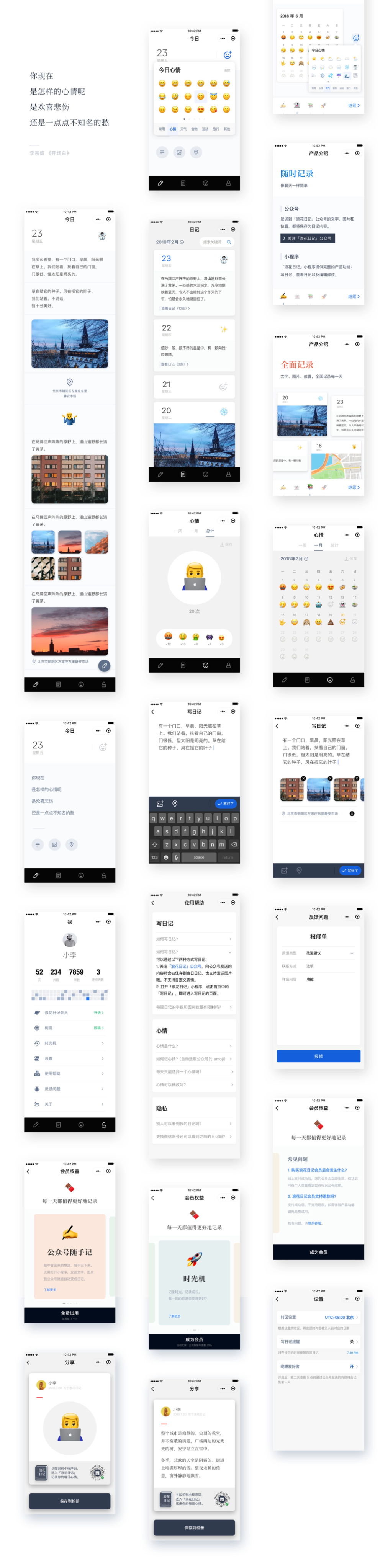
Main pages of Landhua diary.
Thanks for watching!
Navigation


Case study
Langhua Diary
A WeChat mini-app that cares about your mood.
role
Only designer
Platform
WeChat mini-app
My Contribution
UI / UX Design
Product Management
Branding
Introduction
Langhua Diary is a diary app that tries to make writing diary simpler. Unlike other diary products, Langhua Diary integrates with WeChat official accounts , and any time you send text, pictures, location and other information to the official accounts, it becomes the diary of the day, as simple as chatting.
In terms of diary functions, Langhua Diary has also made a lot of interesting attempts, such as mood calendar and time machine: the "mood of the day" design has been added to the product, which allows you to choose the most compatible emoji as the mood of the day and summarize it into mood trends, which can be viewed by week, month and all, so you can see your recent mood fluctuations directly; the time machine function will remind you of what you wrote a month ago or a year ago.
Welcome to search "浪花日记" on WeChat to experience it.
*"Langhua" means sea spray in english.

The inspiration
About ten years ago, I was a user of a journal product named “Ohlife”. Like all great ideas, OhLife works quite simple: Every day, OhLife will send you an email that asks: How did your day go? All you have to do is reply to the email; then the content will be recorded as your journal of the day.
What makes Ohlife a great product?
Despite its elegant website design, Ohlife creates a brand new way to write journals. To those people who don't keep a digital journal, writing journals could be a burden. Writing journals mean these procedures: sign in the website, write down your feeling, upload a photo. Then repeat it the following days. That's why it's hard to build a habit of journaling, although there are many journal tools on the market.
Email is different, and people use it almost every day. Journaling and email seem like different kinds of product and not relevant at all. But when Ohlife put them together into one product, something interesting happened: it makes writing journals much easier and less stressful.
- First, you don't need to remind yourself to write journals anymore, it's a great relief. Whenever you open your email, it's there, just reply.
- Second, it makes the writing experience personal. You can decide when to reply and what to write. And the content is entirely based on your mood, if you have a meaningful day, you can write down the whole story; if you feel tired and don't want to talk, just ignore the email, it's fine. It's incredibly flexible.
Overall, Ohlife is a simple and neat tool without any clutter. I kept writing about 1000 journals until it had shut down in 2014. After Ohlife closed, I tried some journaling products with similar features, but almost all of them were far from Ohlife in terms of design and experience. So I went back to the physical handbook.
In the next few years, instant messaging tools at home and abroad developed rapidly and gradually occupied more and more usage scenarios, especially after WeChat released its mini-programs, we started to think of tools that combined diary and IM.
Ohlife website screenshot
Ohlife website screenshot: Journal page
Where to start?
WeChat occupies a large amount of users' screen time and gradually expands the scenario from chatting to shopping, finance, travel and many other fields. It is one of the absolute "high-frequency" products among all products, and users have formed the habit of opening it every day to check it, so there is no need for additional memory burden. To create a new product, we need to establish a mapping relationship between "scene" and "product" in users' minds, and only when the mapping relationship is strengthened to a certain extent will users remember to open this product when they encounter similar scenes. Following Ohlife's idea, we added "diary writing" to users' daily use paths, without the need to establish the mapping between "scenes" and "products", and let users do the diary writing naturally. The most common operation of users in WeChat is chatting with their friends, so if we can finish the diary writing process through chatting, it will not need to change users' usage habits at all, and it will be a natural process for them.
Goal
Langhua Diary aims to make "keeping a diary" as simple as chatting.
Product Exploration
How to write a diary?
To achieve a "natural" diary-writing process, we thought of using a public account. Besides publishing content, a public account can also receive messages from users. By integrating the mini-program with the WeChat public account, we can enable users to send text, images, location information, and more to the public account at any time, which then becomes that day's diary entry. The process feels like confiding in a close friend. Additionally, considering users' familiarity with mini-program products, the mini-program also needs to have comprehensive diary functionalities: writing, viewing, editing diaries, and checking personal information. Thus, we began conceptualizing the design of the mini-app.
We decided to use WeChat public account and mini-app to build this product.
What is the core of a diary?
Before we started planning the features of the diary app, we were thinking: What is the core of a diary?
The answer we found was that diaries are about moods. Everyone's mood inevitably goes through ups and downs, happy, sad, frustrated, uncertain ...... these particularly private emotions are usually not easy to express, and there is usually no product to record these moments, and the positioning of the diary is a private space, so "record user mood" also became our goal.
Mood
Mood
The development of instant messaging tools and social networks has brought about a variety of personalized ways of expression. Text alone can no longer meet users' expressive needs, and more and more users prefer to use emojis or GIFs to convey emotions. Emoji has even become a standard feature across all social platforms and communication tools.
The reason lies in the simplicity, intuitiveness, and universality of emojis, which can convey complex emotions with almost no learning required. Therefore, we designed the "Mood" feature. Users can set their mood for each day's diary, and they can also set multiple moods throughout the day. If users send an emoji to the mini-program via the WeChat official account, we will also recognize it as the mood for that day.
When writing diaries as children, we would often note the weather of the day. This scenario reminded us that, in addition to genuinely recording "moods," the concept of mood also has strong versatility—it can be used to note the weather, exercise, work, and even food. To this end, we referred to the annual Emoji rankings released by Emojipedia, as well as the classification of emojis by platforms such as iOS, Android, and WeChat, and re-categorized them based on the context of diary writing.
Add mood for the day.
The concept of mood also has strong versatility—it can be used to note the weather, exercise, work, and even food.
Mood Calendar
Mood is not a fragment, but a continuous experience, so more than the daily mood, we are concerned about long-term mood changes, through a longer cycle of mood records, in order to reflect the recent in experiencing lows or highs, has been the need to make adjustments.
That's why we provide the function to view the mood trend visually on the product: mood calendar. The mood calendar aggregates the moods set by the user every day by month and displays them in the calendar so that users can quickly review the mood trends for the month and see the ups and downs of their mood.
Mood calendar
Content format
Digital products have a natural advantage in the richness of recorded content, such as posting sentiments, sending pictures, and sending locations have become daily operations for users. We also took advantage of this advantage to add support for multimedia formats such as pictures and locations to the diary product, and to achieve the function of recording the pictures and locations sent by users directly through the public into the diary of the day.
Texts, images, mood, locations were supported in diary.
Let every moment of different moods have a way to be recorded
In Langhua Diary, you can record text, emojis, images, and locations. By combining these formats, you can create a diary experience that meets the needs of different types of users.
For example, if you have an active mind and constant inspiration, you can use the diary as an idea collection box, jotting down thoughts as they come to you through the public account.
For example, when you're in a bad mood and don't feel like talking, you can send an emoji to represent your feelings; when you do feel like talking, you can also write lengthy text.
For example, if you enjoy photography, you can post the photos you take each day to the public account, turning your diary into your photo album.
For example, when going out for fun, you can add a location and pictures taken at each new attraction in your diary, making it your travelogue.……
No matter what mood or situation you're in, Langhua Diary can flexibly help you record your day.
Time Machine
Diaries are not only about the present moment but also about memories. It's an interesting experience to look back at previous entries after some time. In the product, we've added the Time Machine feature, which allows you to review diaries written some time ago.
Visual Design
Writing and Reading Experience
Visually, the most important aspects of a diary are the writing and reading experience. Although digital products offer far more features, the tactile experience of writing with pen and paper is unparalleled. Additionally, we appreciate the reading experience provided by a well-designed magazine.
The diary product aims to convey a gentle and elegant reading and writing experience, just like a well-designed magazine.
Layout
Although we cannot directly replicate this writing and reading experience, we can simulate this sense of familiarity through visual elements and typography, so the initial exploration primarily focuses on these two directions.
Design exploration of the diary page.
Color
We hope that users can express themselves freely and relaxedly while writing their diaries. To visually minimize the pressure of usage, we have pursued simplicity in both color and style, making extensive use of white and light gray. For the highlight color, we chose a deep blue that conveys the feeling of "ocean waves" and resembles the color of the sea.
Color palette
Icon
We hope the product can create an approachable, friendly, and relaxed environment, so we adopted soft, simple wireframe icons in the design.
Color palette
Logo
The diary product is called "Langhua Diary"("Langhua" means spray in english). How should the visual image of "Langhua" be conveyed? And how can it communicate that it is a product related to diaries? Or should a simpler and more understandable icon of a pen or notebook be designed?
Design inspiration
After many attempts with "Langhua," I suddenly realized that the abstract shape of ocean waves closely resembles the strokes left by a fountain pen on paper, which inspired the design of the product logo.
Logo design exploration
Information architecture
The design exploration process favored individual pages that lacked a unified structure, so it was necessary to stop and consider the product's information architecture.
Today
The main scenario we envision is using the WeChat public account to keep a diary, with the mini-program serving as an auxiliary tool. Apart from newly registered users, most of the traffic for the mini-program comes from the viewing links returned by the public account after a diary entry is successfully recorded. Therefore, the most important functions in the diary mini-program revolve around today's diary, including viewing and writing diary entries.
Past Days
At the same time, to make it easier for users to view past diaries, we have also placed "Past Days" in the navigation, organized by month.
Moods
"Moods" is one of the more interesting features of the product, simple and versatile enough to motivate users to try our product. We wanted to promote this feature to users and make "Moods" a separate navigation feature.
Personal
Additionally, user data, settings, and other functions have been integrated into the "Personal" page.
Main pages of Landhua diary.
Final Design
Welcome to search "浪花日记" on WeChat to experience it.
Main pages of Landhua diary.
Thanks for watching!
Navigation


Case study
Langhua Diary
A WeChat mini-app that cares about your mood.
role
Only designer
Platform
WeChat mini-app
My Contribution
UI / UX Design
Product Management
Branding
Introduction
Langhua Diary is a diary app that tries to make writing diary simpler. Unlike other diary products, Langhua Diary integrates with WeChat official accounts , and any time you send text, pictures, location and other information to the official accounts, it becomes the diary of the day, as simple as chatting.
In terms of diary functions, Langhua Diary has also made a lot of interesting attempts, such as mood calendar and time machine: the "mood of the day" design has been added to the product, which allows you to choose the most compatible emoji as the mood of the day and summarize it into mood trends, which can be viewed by week, month and all, so you can see your recent mood fluctuations directly; the time machine function will remind you of what you wrote a month ago or a year ago.
Welcome to search "浪花日记" on WeChat to experience it.
*"Langhua" means sea spray in english.

The inspiration
About ten years ago, I was a user of a journal product named “Ohlife”. Like all great ideas, OhLife works quite simple: Every day, OhLife will send you an email that asks: How did your day go? All you have to do is reply to the email; then the content will be recorded as your journal of the day.
What makes Ohlife a great product?
Despite its elegant website design, Ohlife creates a brand new way to write journals. To those people who don't keep a digital journal, writing journals could be a burden. Writing journals mean these procedures: sign in the website, write down your feeling, upload a photo. Then repeat it the following days. That's why it's hard to build a habit of journaling, although there are many journal tools on the market.
Email is different, and people use it almost every day. Journaling and email seem like different kinds of product and not relevant at all. But when Ohlife put them together into one product, something interesting happened: it makes writing journals much easier and less stressful.
- First, you don't need to remind yourself to write journals anymore, it's a great relief. Whenever you open your email, it's there, just reply.
- Second, it makes the writing experience personal. You can decide when to reply and what to write. And the content is entirely based on your mood, if you have a meaningful day, you can write down the whole story; if you feel tired and don't want to talk, just ignore the email, it's fine. It's incredibly flexible.
Overall, Ohlife is a simple and neat tool without any clutter. I kept writing about 1000 journals until it had shut down in 2014. After Ohlife closed, I tried some journaling products with similar features, but almost all of them were far from Ohlife in terms of design and experience. So I went back to the physical handbook.
In the next few years, instant messaging tools at home and abroad developed rapidly and gradually occupied more and more usage scenarios, especially after WeChat released its mini-programs, we started to think of tools that combined diary and IM.
Ohlife website screenshot
Ohlife website screenshot: Journal page
Where to start?
WeChat occupies a large amount of users' screen time and gradually expands the scenario from chatting to shopping, finance, travel and many other fields. It is one of the absolute "high-frequency" products among all products, and users have formed the habit of opening it every day to check it, so there is no need for additional memory burden. To create a new product, we need to establish a mapping relationship between "scene" and "product" in users' minds, and only when the mapping relationship is strengthened to a certain extent will users remember to open this product when they encounter similar scenes. Following Ohlife's idea, we added "diary writing" to users' daily use paths, without the need to establish the mapping between "scenes" and "products", and let users do the diary writing naturally. The most common operation of users in WeChat is chatting with their friends, so if we can finish the diary writing process through chatting, it will not need to change users' usage habits at all, and it will be a natural process for them.
Goal
Langhua Diary aims to make "keeping a diary" as simple as chatting.
Product Exploration
How to write a diary?
To achieve a "natural" diary-writing process, we thought of using a public account. Besides publishing content, a public account can also receive messages from users. By integrating the mini-program with the WeChat public account, we can enable users to send text, images, location information, and more to the public account at any time, which then becomes that day's diary entry. The process feels like confiding in a close friend. Additionally, considering users' familiarity with mini-program products, the mini-program also needs to have comprehensive diary functionalities: writing, viewing, editing diaries, and checking personal information. Thus, we began conceptualizing the design of the mini-app.
We decided to use WeChat public account and mini-app to build this product.
What is the core of a diary?
Before we started planning the features of the diary app, we were thinking: What is the core of a diary?
The answer we found was that diaries are about moods. Everyone's mood inevitably goes through ups and downs, happy, sad, frustrated, uncertain ...... these particularly private emotions are usually not easy to express, and there is usually no product to record these moments, and the positioning of the diary is a private space, so "record user mood" also became our goal.
Mood
Mood
The development of instant messaging tools and social networks has brought about a variety of personalized ways of expression. Text alone can no longer meet users' expressive needs, and more and more users prefer to use emojis or GIFs to convey emotions. Emoji has even become a standard feature across all social platforms and communication tools.
The reason lies in the simplicity, intuitiveness, and universality of emojis, which can convey complex emotions with almost no learning required. Therefore, we designed the "Mood" feature. Users can set their mood for each day's diary, and they can also set multiple moods throughout the day. If users send an emoji to the mini-program via the WeChat official account, we will also recognize it as the mood for that day.
When writing diaries as children, we would often note the weather of the day. This scenario reminded us that, in addition to genuinely recording "moods," the concept of mood also has strong versatility—it can be used to note the weather, exercise, work, and even food. To this end, we referred to the annual Emoji rankings released by Emojipedia, as well as the classification of emojis by platforms such as iOS, Android, and WeChat, and re-categorized them based on the context of diary writing.
Add mood for the day.
The concept of mood also has strong versatility—it can be used to note the weather, exercise, work, and even food.
Mood Calendar
Mood is not a fragment, but a continuous experience, so more than the daily mood, we are concerned about long-term mood changes, through a longer cycle of mood records, in order to reflect the recent in experiencing lows or highs, has been the need to make adjustments.
That's why we provide the function to view the mood trend visually on the product: mood calendar. The mood calendar aggregates the moods set by the user every day by month and displays them in the calendar so that users can quickly review the mood trends for the month and see the ups and downs of their mood.
Mood calendar
Content format
Digital products have a natural advantage in the richness of recorded content, such as posting sentiments, sending pictures, and sending locations have become daily operations for users. We also took advantage of this advantage to add support for multimedia formats such as pictures and locations to the diary product, and to achieve the function of recording the pictures and locations sent by users directly through the public into the diary of the day.
Texts, images, mood, locations were supported in diary.
Let every moment of different moods have a way to be recorded
In Langhua Diary, you can record text, emojis, images, and locations. By combining these formats, you can create a diary experience that meets the needs of different types of users.
For example, if you have an active mind and constant inspiration, you can use the diary as an idea collection box, jotting down thoughts as they come to you through the public account.
For example, when you're in a bad mood and don't feel like talking, you can send an emoji to represent your feelings; when you do feel like talking, you can also write lengthy text.
For example, if you enjoy photography, you can post the photos you take each day to the public account, turning your diary into your photo album.
For example, when going out for fun, you can add a location and pictures taken at each new attraction in your diary, making it your travelogue.……
No matter what mood or situation you're in, Langhua Diary can flexibly help you record your day.
Time Machine
Diaries are not only about the present moment but also about memories. It's an interesting experience to look back at previous entries after some time. In the product, we've added the Time Machine feature, which allows you to review diaries written some time ago.
Visual Design
Writing and Reading Experience
Visually, the most important aspects of a diary are the writing and reading experience. Although digital products offer far more features, the tactile experience of writing with pen and paper is unparalleled. Additionally, we appreciate the reading experience provided by a well-designed magazine.
The diary product aims to convey a gentle and elegant reading and writing experience, just like a well-designed magazine.
Layout
Although we cannot directly replicate this writing and reading experience, we can simulate this sense of familiarity through visual elements and typography, so the initial exploration primarily focuses on these two directions.
Design exploration of the diary page.
Color
We hope that users can express themselves freely and relaxedly while writing their diaries. To visually minimize the pressure of usage, we have pursued simplicity in both color and style, making extensive use of white and light gray. For the highlight color, we chose a deep blue that conveys the feeling of "ocean waves" and resembles the color of the sea.
Color palette
Icon
We hope the product can create an approachable, friendly, and relaxed environment, so we adopted soft, simple wireframe icons in the design.
Color palette
Logo
The diary product is called "Langhua Diary"("Langhua" means spray in english). How should the visual image of "Langhua" be conveyed? And how can it communicate that it is a product related to diaries? Or should a simpler and more understandable icon of a pen or notebook be designed?
Design inspiration
After many attempts with "Langhua," I suddenly realized that the abstract shape of ocean waves closely resembles the strokes left by a fountain pen on paper, which inspired the design of the product logo.
Logo design exploration
Information architecture
The design exploration process favored individual pages that lacked a unified structure, so it was necessary to stop and consider the product's information architecture.
Today
The main scenario we envision is using the WeChat public account to keep a diary, with the mini-program serving as an auxiliary tool. Apart from newly registered users, most of the traffic for the mini-program comes from the viewing links returned by the public account after a diary entry is successfully recorded. Therefore, the most important functions in the diary mini-program revolve around today's diary, including viewing and writing diary entries.
Past Days
At the same time, to make it easier for users to view past diaries, we have also placed "Past Days" in the navigation, organized by month.
Moods
"Moods" is one of the more interesting features of the product, simple and versatile enough to motivate users to try our product. We wanted to promote this feature to users and make "Moods" a separate navigation feature.
Personal
Additionally, user data, settings, and other functions have been integrated into the "Personal" page.
Main pages of Landhua diary.
Final Design
Welcome to search "浪花日记" on WeChat to experience it.
Main pages of Landhua diary.
Thanks for watching!